
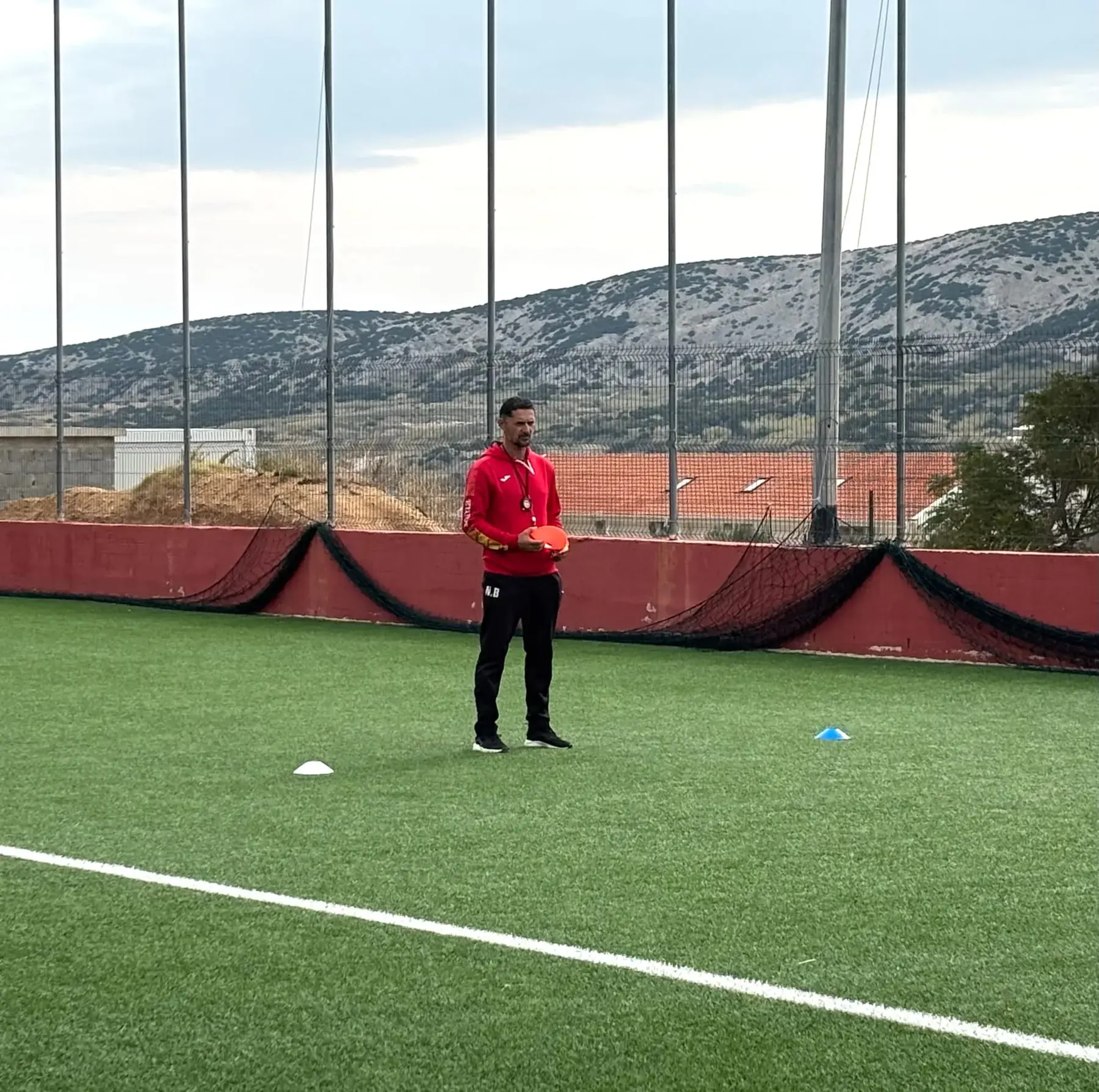
Naum Batkoski emphasizes player development, discipline and understanding of the game in his work. "Football is a school of character," he says at the beginning of the conversation at the Julovica stadium. "If you don't learn the meaning of honesty, community and discipline — the result will never make you better."
Culture before tactics
At a time when clubs increasingly measure success through points, Batkoski claims that real progress begins only when a culture of behavior is established. "In Pag, we started from the ground up: how to come to training, how to say hello, how to respect time. It is not rigor for the sake of rigor, but a way for people to understand that every detail has meaning. When a player starts thinking about a detail, it means that he starts thinking about others."
This idea is not accidental. Batkoski comes from a school where respect and discipline are taught as well as pressing and transition. "You can't play if you don't respect the process. If you don't know why you're running, why you're in the system, you quickly fall apart. People think that tactics is power, but real power is understanding — when a player knows why he's doing something."
"Club culture is not created by speeches, but by consistency. If you see a coach repeating the same thing every day, you start to believe that it makes sense."
Training as an educational tool
Batkoski does not see training as preparation for the weekend, but as a series of situations that build personality. "A mistake is allowed, but the reaction after it shows who you are. We do not punish the mistake here - we analyze it. The player must learn to recognize the moment when he made a mistake and look for a solution himself. This develops responsibility."
Such an approach requires a different rhythm. There is no yelling, no punishment, but there is structure. "Training must be clear, but also humane. If a player doesn't understand what's being asked of him, that's not his problem — it's mine. The coach must be able to explain simply. Football is complex, but not complicated."
Attitude towards young people
He gives special attention to younger categories. "A young player does not need motivation, he needs an example. If he sees seriousness in the senior's work, he naturally takes it over. In Pag, we are trying to create a system where children can see the way — that the point is not just to get to the first team, but to become a person who understands what belonging means."
Batkoski believes that small environments are ideal for development precisely because of the proximity between the club and the community. "Football here is not only played for points, but for the people you know. It forces you to take on additional responsibility. When you see a child from a football school in the stands, you are not playing for yourself, but for all of us."
Pag as a mirror of the system
Naum is aware that Pag will not become an academy that exports talent, but that is not the goal either. "Our goal is for the club to become a place of development. If someone from our system later succeeds in a larger environment — that's a consequence, not a goal. To me, it is more important that we create a standard. When people come and say 'this is a serious business', then you know that the club has an identity."
The coach doesn't talk about ambitions, he talks about processes. "Ambition without structure is chaos. We are going slowly, but smartly. We make small moves that add up. The club must know who it is, not who it wants to be."
"Football is a means, not an end. If through it we learn responsibility, empathy and respect — that's a bigger victory than any place on the table."