
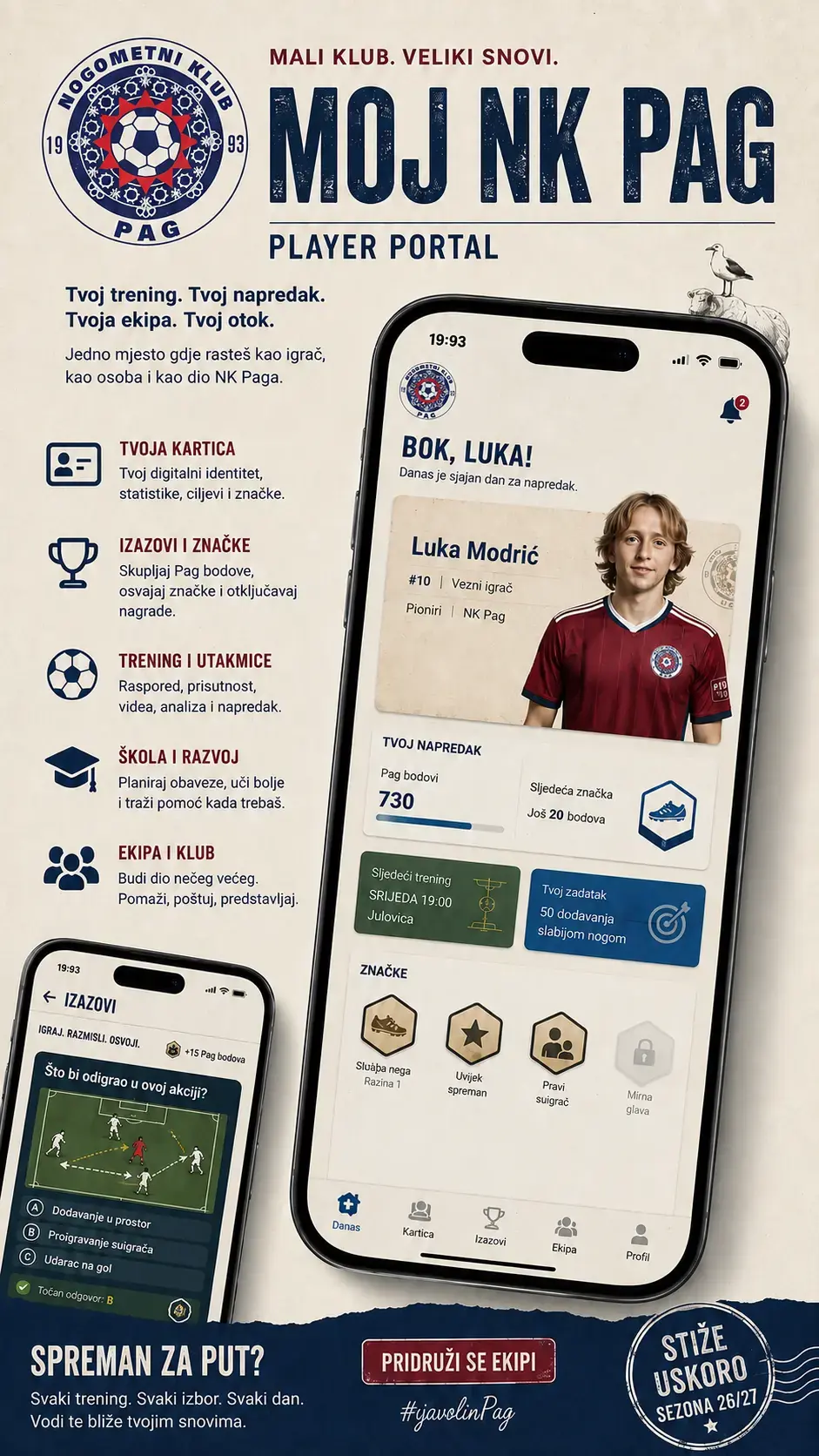
Sports development in NK Pag is entering a new phase — a phase in which the club systematically combines work philosophy and technology. The process is not focused on the result, but on creating an environment in which to learn, think and progress. During the past months, we are preparing the foundations of the system, which will begin to be applied in all categories, from school football to seniors, at the beginning of 2026. The goal is clear: a club that grows from within, through knowledge, structure and daily consistency.
Why technology in a small club makes sense
In large clubs, technology speeds up processes. In small ones, it makes them possible. Small clubs do not have the luxury of numerous coaches, analysts and departments, but they do have what matters most: closeness, community and the will to change. In this context, technology is not a gadget. It is a way to turn experience into knowledge and knowledge into a repeatable system. When every training session, match and decision can be documented and analysed, the club stops depending on individuals and starts learning as an organisation.
Examples from the Nordic countries show that size is not an obstacle, but an advantage if there is a clear structure. Iceland, Denmark and Sweden have developed models in which even smaller clubs use simple digital tools to monitor work and learn through video. Clubs like Mjällby AIF from Sweden have proven that with a consistent process and clear standards, a professional system can be developed even in smaller environments. NK Pag follows the same path — in accordance with its capabilities, but with the same goal: to become a club that understands and transfers knowledge.
How access changes everyday work
Trainings and matches will soon no longer be just activities, but also a source of data. Recording matches and training sessions will allow coaches and players to see what's going on, not just talk about it. Video becomes a tool for conversation — not a means of assessment, but of understanding. Each category, from Papaline to seniors, will have the opportunity to follow their training, analyze reactions, positions and decisions. Children will learn through their own examples, and coaches will have a clearer context for planning.
This approach brings a new kind of discipline and cooperation. When something is seen, it becomes easier to explain, and more importantly — easier to learn. The coach no longer has to constantly explain the same detail, because the child just sees what happened. The coach's role becomes more of a mentoring character: it is not about giving orders, but about helping the player understand the game himself.
Focus on children and learning
At the center of the whole system is the child. Video and analytics are not tools for evaluation, but for understanding and reflection. Young players grow up in a world of images and information — visual learning comes naturally to them. When football is shown to them through that format, everything becomes clearer and more interesting. Mistakes are no longer a problem, but an opportunity for conversation and progress. In this way, technology does not distance children from the game, but connects them to it more deeply than before.
Throughout the season, every player will be able to see their progress not only in tables, but through real situations: how they react under pressure, move without the ball and become involved in the game. Over time, this builds a culture in which children understand that training is not only physical activity, but a process of learning and thinking. That is the difference between a generation that passes through and one that leaves a mark.
Coaches as the foundation of the system
For the system to work, coaches must be connected. That is why the club works in parallel to create a common base of work principles, standards of behavior and a common language. The goal is for all coaches to work within the same shared framework throughout the categories — not in terms of identical training, but in terms of logic and philosophy. This ensures that a child who moves from one category to another does not start over, but continues to build on the same foundations.
The role of technology is there to connect and facilitate, but the core remains human — communication, mentoring and trust. Video analytics only provides a tool that preserves knowledge within the club. If one coach leaves, the system remains. If a new one comes, it can be followed up. This is the way a small club can become stable, long-term and without constant starts from scratch.
Culture of learning and community
This project not only changes the way of training, but also the culture in the club. Through the system of analytics, video database and common standards, NK Pag builds a habit of sharing knowledge and cooperation. Instead of spontaneous solutions, a framework is created in which everything that is done can be repeated, adapted and improved. This creates trust — within the coaching staff, among the players, but also towards parents and the community.
Looking towards 2026
During this autumn, the technical preparation, the choice of recording solutions and the definition of the work methodology are completed. At the beginning of 2026, the system will gradually come into use through the pioneers and then the younger ages. It will be the beginning of a process that is not spectacular from the outside, but changes everything from the inside. Trainings, matches, training of coaches and attitude towards children will be connected by one logic — to understand, analyze, transfer and constantly learn.
Technology is not a goal, but an aid in everyday work. We will measure the success of the project by the regularity of filming, the use of material in training sessions and feedback from coaches and players.